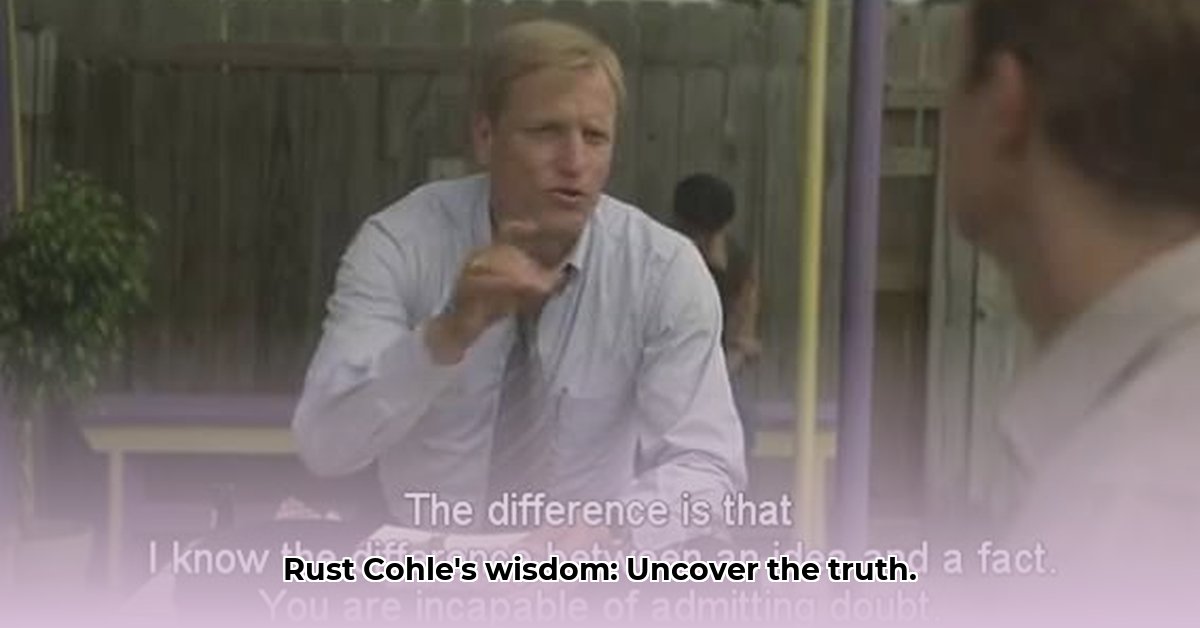
Rust Cohle's Dark Wisdom: A Journey Through Nihilism and Unexpected Hope
Rust Cohle, the enigmatic detective from True Detective, isn't just a compelling character; he's a repository of philosophical pronouncements that resonate long after the credits roll. His worldview, steeped in nihilism and despair, surprisingly offers unexpected insights into the human condition. This isn't about finding easy answers; it's about grappling with the profound questions Cohle poses about time, death, meaning, and the elusive nature of hope itself. Is there meaning in a seemingly meaningless world? Can a nihilistic perspective offer a unique lens for understanding ourselves? Let's delve into the cryptic wisdom of Rust Cohle.
Rust Cohle's Most Provocative Quotes: Exploring Key Themes
Rust Cohle's words are not merely dialogue; they are philosophical probes, inviting us to confront the uncomfortable truths of existence. The following quotes, categorized thematically, invite reflection and a deeper understanding of his complex perspective.
Time's Unrelenting Cycle: "Time is a flat circle." This iconic line encapsulates Cohle's cyclical view of existence, suggesting a relentless repetition of birth, life, and death. It's a potent image highlighting the futility of striving against predetermined outcomes. Does this imply total despair, or a strange form of acceptance?
The Shared Human Journey: "We're all just walking each other home." This statement transcends the bleakness of the "flat circle" to present a shared human experience. Despite our individual struggles, we're all bound by a common destination: death. How does this shared fate impact our individual lives, and how do we make sense of our limited time?
The Illusion of Self: (Implied) "The self is a construct." Cohle frequently hints at the fragility of our sense of self, suggesting it's a collection of experiences and perceptions, not a fixed entity. How does this understanding challenge our personal notions of identity and purpose?
A Glimmer Amidst the Darkness: "If you ask me, the light's winning." This seemingly optimistic statement, uttered within the context of overwhelming darkness, presents a subtle shift. It doesn't negate his overall nihilism but suggests a tenacious clinging to hope – a fragile, hard-won acceptance amidst despair.
Understanding Violence: "People kill because they don't understand." This simple statement exposes the complexities of violence, suggesting a deep connection between empathy and action. What can we learn about the roots of violence by understanding this lack of empathy?
The Nature of Existence: "It's just a bunch of stuff happening." This seemingly simplistic observation highlights the accidental and often chaotic nature of existence, devoid of inherent meaning or purpose. How do we navigate this reality, and does the absence of inherent meaning lead to meaninglessness?
The Absurdity of It All: "Everything is broken." This blunt statement reflects the inherent imperfections and inherent chaos of life. Does this embrace of brokenness lead to despair, or a form of acceptance? What does "brokenness" even mean in this context?
Beyond Animalistic Existence: "We are not animals. We're not just animals." This quote suggests the unique human capacity for self-awareness, reflection, and the search for meaning. This separates us from mere animalistic existence, however, is it enough to provide a solid foundation for meaning in the face of the ultimate void?
Reconciling Nihilism and Hope: The Paradox of Rust Cohle
Rust Cohle's nihilism isn't a static belief, but a constantly evolving perspective. His actions often contradict his words; his dedication to solving the Dora Lange case, for instance, demonstrates a commitment that seems at odds with his despairing pronouncements on the meaninglessness of it all. His statement "the light's winning" doesn't replace his nihilistic worldview, but rather provides a nuanced perspective – an acknowledgement of persistent hope and the ongoing struggle between light and dark. It's a testament to the human spirit's capacity for resilience even in the face of overwhelming odds. Is this an acceptance of the absurdity of existence, a recognition that we're all just "walking each other home"?
Key Considerations:
- How does Cohle's nihilism shape his interactions with others?
- What role does trauma play in shaping his world view?
- Can a nihilistic worldview offer unique insights into the human condition?
- What is the definition of "light" in the context of Cohle's statement. Is it a purely symbolic concept, or something more tangible?
Rust Cohle's words are not easy answers. They're invitations to engage in a deep, introspective exploration of our own place in the universe, prompting us to confront the fundamental questions of existence. His legacy is not one of simple answers, but one of ongoing engagement—a testament to the intellectual and emotional depth of the character, and the show itself.